


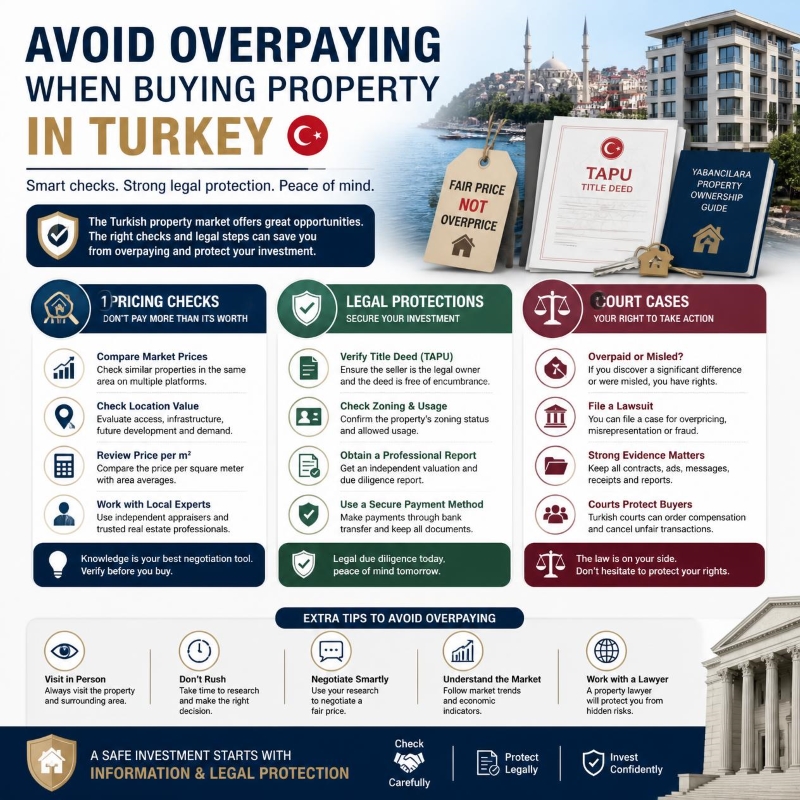
How to Avoid Overpaying When Buying Property in Turkey: Pricing Checks, Legal Protections and Court Cases
Buying a property in Turkey can provide strong lifestyle and investment benefits. However, international buyers sometimes discover that an apartment was sold to them at a substantial premium compared with similar properties in the same building or neighborhood. How to Avoid Overpaying When Buying Property in Turkey.
The risk is especially high when buyers rely only on the seller’s presentation.
Nevertheless, an expensive purchase is not necessarily an unlawful purchase.
Under Turkish law, courts generally distinguish between:
- A buyer who made a commercially poor decision
- A buyer who was given false information
- A buyer whose lack of experience was deliberately exploited
- A buyer who paid for a property that did not match its promised characteristics
- A transaction involving fraud, concealment or manipulated documents
This distinction is crucial. A court will not normally cancel a valid title deed transfer simply because another apartment was available at a lower price.
Can You Cancel a Property Purchase Because You Overpaid?
Usually, not for that reason alone.
Turkey generally respects freedom of contract. Sellers can ask different prices, and buyers are expected to investigate the property before purchasing it.
For a legal remedy to become realistic, there will normally need to be an additional legal basis, such as:
- Fraud or intentional misrepresentation
- Concealment of an important defect
- A fundamental mistake
- Exploitation of the buyer’s inexperience or vulnerable position
- Breach of a contractual promise
- False information about size, title, zoning, rental income or delivery
- A property that materially differs from what was advertised or contracted
Therefore, a buyer saying, “I later found a cheaper apartment,” is in a much weaker position than a buyer who can prove, “The seller knowingly gave me false information to justify the higher price.”
The Main Legal Rule: Excessive Exploitation Under Article 28
Article 28 of the Turkish Code of Obligations regulates aşırı yararlanma, traditionally known as gabin, or excessive exploitation.
The provision applies where:
- There is a clear imbalance between the parties’ performances.
- The imbalance resulted from one party exploiting the other party’s financial distress, thoughtlessness or inexperience.
When these conditions exist, the disadvantaged party may, depending on the circumstances:
- Declare that they are not bound by the agreement and request restitution, or
- Remain bound by the agreement and request correction of the imbalance
The official text of Article 28 therefore requires more than an unfavorable price. It requires both a serious economic imbalance and exploitation of a legally recognized weakness.
Court Case 1: Yargıtay 1st Civil Chamber, 2012/10938 E., 2012/10436 K.
One of the most useful decisions for understanding fraud and excessive exploitation in Turkish property disputes is:
Yargıtay 1st Civil Chamber
Case No.: 2012/10938
Decision No.: 2012/10436
Decision date: 1 October 2012
The case concerned a property transfer challenged on the grounds of mistake, fraud and excessive exploitation.
The claimant stated that she was 71 years old, had been persuaded by family members to transfer the property, had not received the price and had been deceived. The first-instance court rejected the claim partly because it believed the allegations had to be proved through written evidence.
The Court of Cassation overturned that approach.
It held that allegations involving fraud, mistake and excessive exploitation may be demonstrated through witnesses and other forms of evidence rather than only through written documents. The court also instructed that experts should determine the property’s value at the date of transfer.
Why This Case Matters to Property Buyers
The decision establishes several important principles.
First, the court must investigate the property’s actual value at the relevant transaction date.
Second, a serious price imbalance is only the beginning of the analysis. After identifying the imbalance, the court must examine factors such as:
- Age
- Health
- Economic position
- Psychological condition
- Personal experience
- The circumstances surrounding the agreement
Third, fraud and exploitation can potentially be proven through:
- Witnesses
- Messages
- Payment records
- Marketing material
- Expert reports
- Conduct before and after the transaction
The practical lesson is that buyers should preserve every document and conversation connected with the purchase.
Important Limitation
The case did not declare that every transaction involving a low or high declared price must be cancelled.
Instead, Yargıtay required a full investigation into both the price imbalance and the alleged exploitation.
That distinction remains essential for an overpaying buyer.
Court Case 2: Yargıtay 1st Civil Chamber, 2014/745 E., 2014/7040 K.
Another instructive decision is:
Yargıtay 1st Civil Chamber
Case No.: 2014/745
Decision No.: 2014/7040
In this dispute, the claimant argued that a property share had been transferred through fraud. However, the available evidence included a rental agreement indicating that the claimant remained in the property as a tenant after the sale. The signature on that agreement was found by the Forensic Medicine Institute to belong to the claimant.
The fraud allegation was therefore not accepted on the available evidence.
Why This Case Matters
It demonstrates that merely alleging deception is not enough.
Courts examine objective evidence and the parties’ conduct after the transfer. Documents signed after the transaction may contradict a later claim that the seller or buyer did not understand the true nature of the deal.
For an international buyer, this means:
- Do not sign Turkish-language documents you do not understand.
- Obtain an independent translation.
- Keep the translated version.
- Confirm that the Turkish and foreign-language versions match.
- Do not sign acknowledgments stating that the property was inspected or accepted unless that is accurate.
- Do not sign rental guarantees, delivery records or settlement documents without legal review.
A badly worded acceptance document may later undermine a claim involving misrepresentation or defects.
Court Case 3: Yargıtay 1st Civil Chamber, 2022/1575 E., 2022/2082 K.
This decision, dated 14 March 2022, involved allegations that property transfers were completed after the claimant was led to believe the sale price had been paid.
The claimant asserted that money had supposedly been deposited into another person’s account and that the properties were transferred based on that belief. The dispute included claims for cancellation of the title deed or, alternatively, payment and compensation.
Why This Case Matters
It highlights the importance of proving the actual payment flow.
In Turkish property purchases, a buyer should be able to connect every payment to:
- The named buyer
- The named seller or developer
- The correct property
- The correct contract
- The agreed purchase price
- The date and purpose of payment
Payments through unrelated individuals or informal channels create serious evidentiary risks.
A buyer should avoid:
- Cash payments without receipts
- Transfers to an agent’s personal account
- Payments to an unrelated company
- Undocumented cryptocurrency payments
- Different prices appearing in the reservation form, contract, bank transfer and title deed record
- Signing documents stating that the full price was paid before it was actually paid
Each bank transfer should include a clear explanation, such as the project name, unit number and instalment purpose.
Court Case 4: Constitutional Court Application No. 2017/38634
In a separate property-related dispute, the Turkish Constitutional Court considered the repayment consequences of an unsuccessful or invalid property transaction.
The Court referred to the principle of denkleştirici adalet, or equalizing justice. Under this approach, repayment may need to preserve the purchasing power of the money originally paid rather than merely returning the same nominal amount years later.
Why This Case Matters
Property disputes can take years. During that time, inflation and currency movement may substantially reduce the real value of money.
Where a transaction is invalidated or payments must be returned, the legal calculation may become more complicated than simply returning the original numerical amount.
However, buyers should not assume that every successful property claim automatically produces:
- Foreign-exchange compensation
- Full investment profit
- Lost rental income
- Market appreciation
- Interest from the payment date
The precise remedy depends on the legal basis of the claim, the contract, fault, notice dates, evidence and the court’s calculation method.
Fraud and Misrepresentation Under Article 36
Article 36 of the Turkish Code of Obligations deals with intentional deception.
A buyer may have a stronger case where the seller, developer or contracting party knowingly provides false information that causes the buyer to enter the agreement.
Examples may include false statements that:
- The apartment has an unobstructed sea view
- The view can never be blocked
- A metro station has been officially approved
- The property is eligible for Turkish citizenship
- The unit has a residential title deed when it is registered differently
- Short-term rentals are legally permitted
- The apartment has a guaranteed rental return
- The project has obtained all required permits
- The usable area is substantially larger than its actual area
- A particular unit is the final unit available at that price
- The asking price is a government-approved value
- The buyer is receiving a unique foreign-investor discount
In the 2012 Yargıtay decision discussed above, the court described fraud as deliberately causing or maintaining a mistaken belief that leads another person to enter a transaction. It also confirmed that fraud may be proven by different forms of evidence.
Sales Talk Versus Legally Relevant Misrepresentation
Not every exaggerated marketing phrase will amount to actionable fraud.
Statements such as “excellent investment” or “one of Istanbul’s best locations” may be considered general promotional language.
More legally significant statements are measurable and verifiable, such as:
- “The net area is 145 m².”
- “The monthly rent is contractually guaranteed for three years.”
- “The title deed is residential.”
- “The project has an occupancy permit.”
- “The seller has no mortgage or lien.”
- “This unit qualifies for citizenship.”
- “The price is 15% below the developer’s official price list.”
The more precise the claim, the easier it may be to test and document.
The Official Valuation Report Does Not Guarantee a Fair Deal
Foreign buyers often assume that an official valuation report guarantees that they are not overpaying.
That assumption is unsafe.
A valuation report is important, but it should not replace independent market research. It may have been prepared for a specific administrative or lending purpose and may use broader comparable data than an investor would use.
A careful buyer should compare:
- The seller’s asking price
- The negotiated purchase price
- The official valuation
- Comparable resale listings
- Verified recent transactions where available
- Prices of other units in the same development
- Expected rental income
If the purchase price is substantially higher than the valuation, the difference should be explained in writing.
Possible legitimate explanations include:
- Superior floor
- Exceptional view
- Private terrace
- Larger net area
- Furniture package
- Extended payment plan
- Commercial payment financing
- Rare unit type
“Foreign-buyer pricing” is not a satisfactory explanation.
Case Study: The Foreign-Buyer Price List
Imagine that an international buyer is quoted €500,000 for an apartment.
The agent says:
- The price is a special developer price.
- Only one unit remains.
- The apartment has a guaranteed rental income.
- The price will increase the following week.
- The apartment is suitable for citizenship.
After purchasing, the buyer discovers:
- Turkish buyers were offered similar units for €400,000.
- Several units were still available.
- The rental guarantee was not included in the contract.
- The valuation report assessed the unit at €370,000.
- The citizenship suitability statement was never legally confirmed.
Does the buyer automatically win a court case?
No.
But the buyer’s case may become substantially stronger if there is evidence showing that the seller knowingly made specific false statements to induce the transaction.
Useful evidence could include:
- Separate domestic and foreign price lists
- WhatsApp conversations
- Email promises
- Screenshots of advertisements
- Audio evidence obtained lawfully
- The official valuation report
- Contracts offered to comparable buyers
- Bank payment records
- Statements from witnesses
- Developer inventory records
- Written rental guarantees
The central question is not merely whether the price was high. It is how the high price was obtained.
How Courts Determine the Property’s Real Value
When market value becomes relevant in litigation, the court may appoint one or more experts.
The assessment may consider:
- Location
- Transaction date
- Building age
- Construction quality
- Floor and orientation
- View
- Net and gross area
- Legal status
- Zoning position
- Occupancy permit
- Comparable sales
- Public transport
- Social facilities
- Renovation condition
- Encumbrances and restrictions
The valuation date is critical.
A 2026 valuation cannot automatically establish that a buyer overpaid in 2023. Courts generally need to determine the property’s value at the time of the challenged transaction.
Legal Deadlines Can Be Very Short
Claims involving mistake, fraud or excessive exploitation may be subject to strict time limits.
The 2012 Yargıtay decision emphasized the significance of the one-year period applicable to the legal grounds considered in that case. It also discussed when the relevant period begins and the need to investigate the facts properly.
Article 28 currently contains a more detailed timing framework for excessive exploitation. The deadline may depend on when the thoughtlessness or inexperience ends, or when the distressed situation disappears, together with an ultimate time limit calculated from the agreement.
Because the correct deadline depends on:
- The contract date
- The title deed date
- The discovery date
- The legal basis of the claim
- Whether the contract is preliminary or final
- Whether the buyer is claiming fraud, defect, breach or exploitation
a buyer who suspects serious misconduct should obtain advice from a Turkish property lawyer immediately.
Waiting for prolonged negotiations with the agent or developer may put legal rights at risk.
Ten Checks to Complete Before Agreeing on Price and to Avoid Overpaying When Buying Property in Turkey
1. Obtain two independent price analyses on the Turkish Property
Do not rely only on the selling agent.
Request assessments from professionals who are not receiving their commission solely from that particular property.
2. Compare genuine equivalents
A meaningful comparable should have a similar:
- Micro-location
- Building quality
- Age
- Floor
- Orientation
- View
- Net area
- Title status
- Delivery condition
- Payment structure
Comparing a completed sea-view apartment with an off-plan rear-facing unit is unreliable.
3. Separate property cash price from instalment price
A three-year payment plan contains financing value.
Do not compare a €400,000 cash unit directly with a €450,000 unit payable over several years without calculating the financing difference.
4. Calculate the price using net area of the property
Use the area you can actually occupy.
5. Review the independent valuation before full payment
Do not wait until the title deed appointment to discover a major valuation gap.
6. Verify title and legal status
Check:
- Registered owner
- Mortgages
- Liens
- Annotations
- Easements
- Property type
- Land share
- Construction servitude
- Condominium ownership
- Occupancy status
7. Put every promise in writing
A promise not included in the contract may become difficult to enforce.
This includes:
- Rental guarantees
- Furniture
- Parking
- View protection
- Completion date
- Refund rights
- Citizenship-related obligations
- Penalties for delay
8. Use an independent lawyer
The developer’s lawyer protects the developer.
The agent’s standard contract may protect the agency.
Your lawyer should be independent from the seller, developer and intermediary.
9. Make traceable payments
Use banking channels and state the property and instalment purpose clearly.
10. Refuse artificial urgency
Statements such as “the price expires tonight” or “another buyer is transferring the deposit now” should not replace proper due diligence.
Documents That Can Prove Overpricing or Misrepresentation
Preserve the following:
- Original listing
- Screenshots showing the date
- Brochures
- Price lists
- Reservation agreement
- Sales contract
- Title deed record
- Valuation report
- Approved architectural plan
- Bank receipts
- Currency-conversion records
- WhatsApp conversations
- Emails
- Rental projections
- Written promises
- Translation records
- Delivery and inspection forms
- Comparable listings from the same period
Create a digital evidence file before the listing or messages disappear.
Red Flags That Suggest You May Be Overpaying
Be particularly cautious when:
- The agent refuses to provide the unit price list.
- The net area is not stated.
- The price changes depending on your nationality.
- A large commission is hidden inside the sale price.
- The valuation report will only be shown after payment.
- The seller insists on cash.
- Money must be sent to a third party.
- The contract price differs from the actual payment.
- Rental returns are promised only verbally.
- Citizenship eligibility is presented as guaranteed.
- You are discouraged from hiring a lawyer.
- You are told not to speak with other owners.
- The same apartment appears online at a lower price.
- The reservation fee is described as non-refundable in every circumstance.
- You are pressured to sign untranslated documents.
What to Do If You Believe You Already Overpaid
Do not begin by accusing everyone of fraud.
First, build an evidence-based comparison.
Step 1: Collect all records
Save contracts, messages, advertisements, receipts and valuation reports.
Step 2: Commission a retrospective valuation
Ask a qualified expert to assess the property’s market value on the date you purchased it.
Step 3: Identify the exact false statement
“Too expensive” is not specific enough.
A stronger allegation may be:
- The area was falsely stated.
- The title status was misrepresented.
- The view was shown using a different unit.
- The rental guarantee did not exist.
- The price list was manipulated.
- A material legal restriction was concealed.
Step 4: Calculate the financial difference
Separate:
- Alleged overpayment
- Commission
- Taxes and fees
- Financing expense
- Defect repair costs
- Lost rent
- Currency effects
Step 5: Have a lawyer classify the claim
The possible legal basis might be:
- Excessive exploitation
- Fraud
- Fundamental mistake
- Defective performance
- Breach of contract
- Unjust enrichment
- Professional negligence
- Consumer law, depending on the parties and transaction
The correct classification affects the evidence, court, remedy and deadline.
Frequently Asked Questions
Is it illegal to charge a foreign buyer more?
A price difference is not automatically unlawful merely because the buyer is foreign.
However, liability may arise where the higher price results from fraud, discriminatory conduct prohibited by applicable law, undisclosed conflicts, false representations or deliberate exploitation.
Can the official valuation report prove that I overpaid?
It can be important evidence, but it is not automatically conclusive.
The valuation date, purpose, methodology and comparable properties must be examined.
Can I cancel the title deed transfer?
Possibly, but only where a valid legal ground is established.
A simple difference between the purchase price and later-discovered market prices will not normally be enough.
Can I recover only the excessive portion?
Article 28 may permit the disadvantaged party, in appropriate circumstances, to remain bound by the agreement and request elimination of the imbalance rather than cancelling the entire agreement. Whether that remedy is available depends on the facts and the court’s assessment.
Can WhatsApp messages be used as evidence?
Messages may be evidentially valuable, although admissibility, authenticity and the way evidence was obtained must be legally assessed.
Keep the original device, export the complete conversation and avoid relying only on cropped screenshots.
Does a high commission prove fraud?
No. However, an undisclosed commission built into the price may be relevant where the intermediary falsely represented itself as independent or concealed a conflict of interest.
Final Advice: The Cheapest Property Is Not Always the Best Value
Avoiding overpayment does not mean buying the lowest-priced apartment.
A higher price may be commercially reasonable for a property with:
- A genuinely superior view
- Better construction
- Stronger developer reputation
- Larger usable area
- Better title status
- Higher rental liquidity
- A rare floor plan
- Better transport access
- A realistic payment plan
The goal is to determine whether the premium is supported by measurable value.
A careful buyer should be able to answer three questions before signing:
- What are comparable properties actually worth?
- Why does this property deserve its price premium?
- Which documents prove every important sales promise?
If those questions cannot be answered clearly, the buyer should not be pressured into paying a deposit.
Buy With Confidence Through Eleven Estate
At Eleven Estate, we help international buyers examine more than the advertised price.
Our property selection process can include:
- Comparable-project analysis
- Price-per-square-meter assessment
- Cash and instalment comparisons
- Review of developer price structures
- Coordination with independent legal and valuation professionals
- Title deed and purchase-process support
- Negotiation of price and commercial terms
- Assistance with citizenship-related property selection
Our objective is not simply to sell a property. It is to help buyers understand whether the property, price and long-term investment case make sense.
Contact Us – www.info@elevenestate.com to explore selected properties in Istanbul and across Turkey.
Legal Disclaimer
This article provides general information. It does not constitute Turkish legal advice, a legal opinion or a guarantee concerning the outcome of any dispute. Court decisions depend on their individual facts, and judicial approaches may develop over time. Anyone facing a property dispute should consult an independent lawyer admitted to practise in Turkey.
